
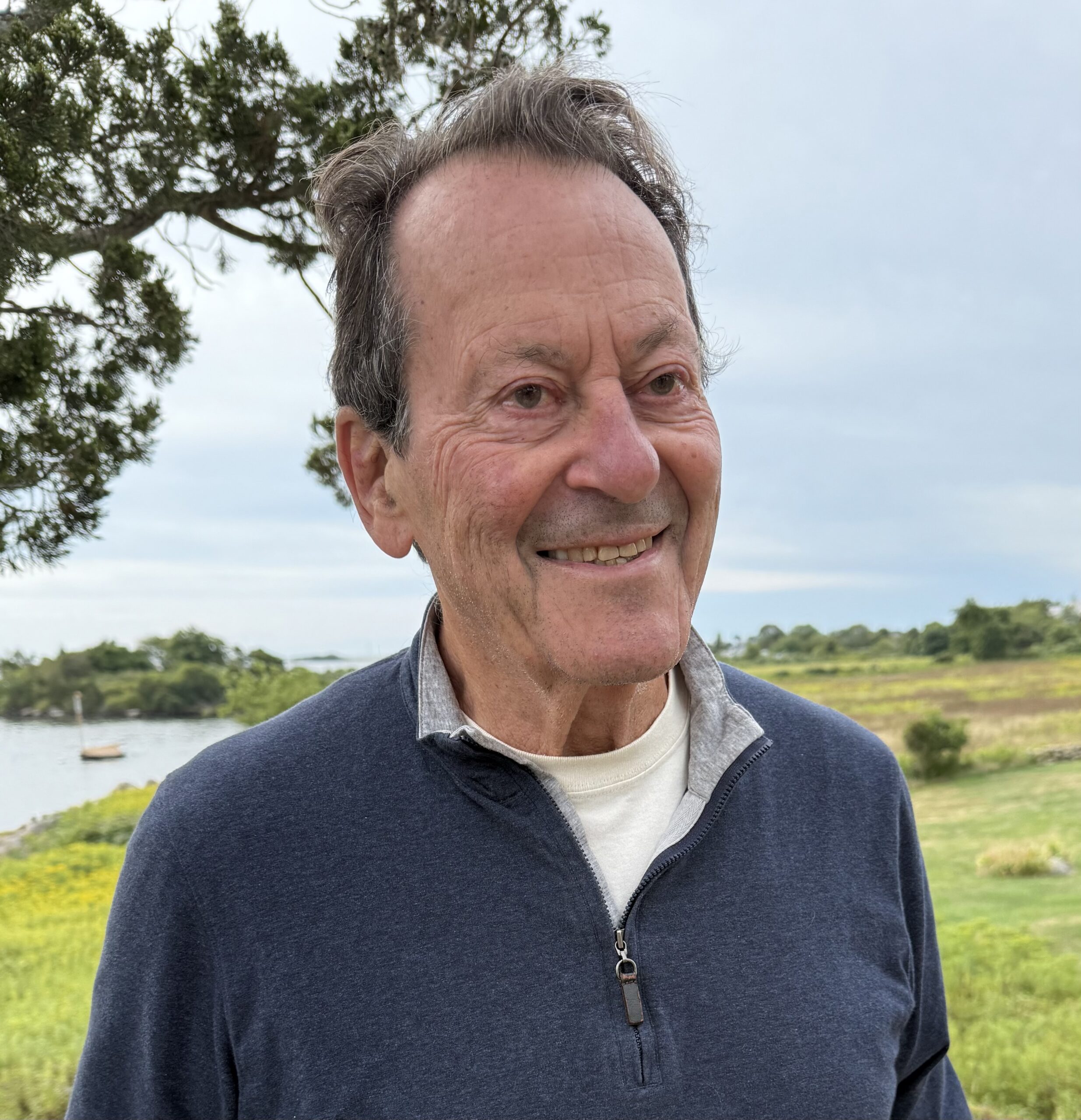
Every era of food television has its marquee names—but behind every legend is the producer who shapes the spotlight. Geoffrey Drummond holds a unique place in that pantheon: he was the last producer that PBS Grand Dame Julia Child ever worked with. When Julia came out of retirement for her final series, it was Drummond behind the camera, helping orchestrate what would become her graceful, groundbreaking coda. Without that late act, it’s fair to wonder whether the rock-star chef revolution that followed would have ever found its footing. In an exclusive interview, Drummond spoke with KLCS to talk about his path to Julia, the backstage moment he’ll never forget, and how he’s had a quiet hand in nearly every major PBS cooking show that turned the craft of cuisine into a stage for a new kind of celebrity. Read on for an inside look at the producer who helped Julia Child pass the torch—before the foodiverse exploded.
Whenever I watch Baking with Julia, I always see your name and I wondered what happened to you. The show still airs on Create TV, and your name is very prominent. You left and you’ve done Food Lab. Is that what you are currently doing?
GD: I did food shows for 35 years. We started in New York with a series called New York’s Master Chefs, which basically featured that first generation of public chefs way before there was anything called “celebrity chef.” And we did that, and it was a public television show that was a documentary, and it was 13 shows going behind the doors of the restaurants that had become the New York restaurants, like the Four Seasons, like Le Cote Basque, like Lutèce; several of those people are no longer with us. Lydia Bastianich, whose show I produced for about 10 years was one of those original chefs in the ‘80s, but PBS didn’t give her her-own show until I want to say…1993 or ‘94.
Yes, something like 1998.
GD: And Julia had stopped doing regular television in 1983, right when we were doing our documentaries, and I know she knew about them because we talked about it. Our series was nominated for an Emmy back when there weren’t, remember Food Network didn’t start until ’92 or so, so PBS was the place for food shows, and PBS was really Julia Child. And then there were others. Jacques was doing shows, but Jacques was kind of in a, definitely, a different tier. The only other really big public television chef at the time was The Frugal Gourmet.
I have a book that he signed for me.
GD: And he was a disaster. We produced his show for several seasons.
I met him when I was a journalism intern and I went to his kitchen; I think there was a mess going on then. I just went to meet him and get an autograph, and he blew up at me. I think something was blowing up in his life, or the press.
GD: He was blowing up constantly, and had definite issues, which ended up taking him down. But there was a time when he was the most popular TV cook, more than Julia. Many books sold.
I have his book!
GD: But when we did this series, the word was, “Yeah, you guys got nominated for an Emmy,” and this was way back, and we lost to I think the show was Cops because all of these second-tier shows were not network shows and got lumped into one category. But the word was that “You really need to have a host that you can hang the series onto.” And in the middle ‘80s I was friends with Jacques Pepin, and Jacques said “You ought to talk to Julia.” And I said. “Well, I thought she was retired.” He said, “Yeah, but I think she’d really like to work, and continue working and doing TV.” And here she is in her late 70’s, and with Jacques generous help, I went up to Cambridge and met with Julia. His help as in, he made a call, he was friends with Julia.
Jacques, who’s so kind, he signed my book plate. He mailed it in an envelope with his physical address. I was like, people don’t do that anymore!
GD: People would say to me, “Is there any way I can get in touch with Julia?” I’d say, “Yeah, call her up.” She was in the phone book and you called her up, and she picked up the phone.
I saw her once, it was behind Harvard Square, it was the mid-90s, she was driving a bright red boxy Volvo sedan. I told Steven Raichlen this story.
GD: And you know the story behind that? She used to have, I think it was a brown Volvo station wagon or sedan, and she had a little accident; she was having issues about driving. And myself and her attorney and her assistant said, “It may be time to stop driving,” and she said, “No, I’ll just get a bright red car so everybody can see me.” And that’s what she did. Bill Preslow, who was her attorney, told her: “You know Julia, the problem isn’t about people hitting you, the chance that you hit let’s say a young student at Harvard, the publicity would be terrible,” and that’s when she stopped. But yes, that was her car. A red Volvo.
When I see credits of Baking with Julia, you were her final producer, right?
GD: Yeah. But we produced four different TV series, not just Baking, we did Cooking with Master Chefs, which was the show that, and I give her complete credit for it, was the show that introduced celebrity chefs, before they called them “celebrity chef.” When you look at people who were in that show generationally, starting with Emeril Lagasse, who was the kickoff show, he was just terrific. But people like Nancy Silverton, like Alice Waters, like Jeremiah Tower, and Hubert Keller, and I used to see him all the time, and Charlie Palmer, as well as people like Jacques was in. That was the beginning of celebrity chefs and everybody loved it and it did really well and won an Emmy. It helps having a superstar as your host to win an Emmy, it’s not just that the shows were good, and she was so good. She was just an incredible, incredible talent. She was a great teacher, she had terrific charisma, she was funny, she was unpredictable, she was all of those great things. And that first series, we originally pitched it as like “Masterpiece Cooking,” it was almost like Masterpiece Theater, it was just PBS, there was no Food Network at the time. I said, ‘Julia, you can introduce each show and do the wrap up and it’ll be like Alistair Cooke does on Masterpiece Theater, she said, “I’ll be the Alistair Cooking.” She loved that, Sesame Street picked up on that and used that line. That was Cooking with Master Chefs. The next one was In Julia’s Kitchen with Master Chefs, because the first one we travelled all over the country. We went from Hawaii, to Boston, to New York, New Orleans, to Dallas and so on. And the second series, we decided “Let’s do it in Julia’s kitchen.” It was like creating Mecca, creating the grand pyramid, the Taj Mahal – the chefs just loved coming there, because this was Julia’s kitchen. And the other shows that she had done, were not done in her kitchen, they were done in studio. So people just loved that. I think we did 39 shows with that; and then we did Baking after that.
She’s the original cooking at home influencer, too.
GD: She was, and continues to be in a way.
I am curious, the end credits say Maryland Public Television, not her home station WGBH, in Boston. Were they no longer associated with her at that point?
GD: We did the first series with Maryland because my partner at A La Carte. Nat Katzman, he was the general manager of KQED at San Francisco and then he left and we started A La Carte. He was very tied-in to public television and Maryland Public Television, at the time, was very entrepreneurial. And, I think that WGBH felt that they had done their Julia thing; Julia’s original producer had moved on to do This Old House and stuff like that. We started with Maryland and then went to KQED, so, Julia and Jacques were done with KQED. I don’t know if we ever did anything directly with WGBH, they tend to want to control everything. We did those TV specials with Julia called Cooking in Concert with Julia and Jacques, with Julia and Graham Kerr, remember Graham Kerr, the Galloping Gourmet? We did all of those live specials which were like comedy specials, almost. And that’s what set up the idea, for when I pitched the idea of doing Julia and Jacques cooking at home; it was based on the live TV thing that we did at Boston University called Cooking in Concert, which everybody loved.
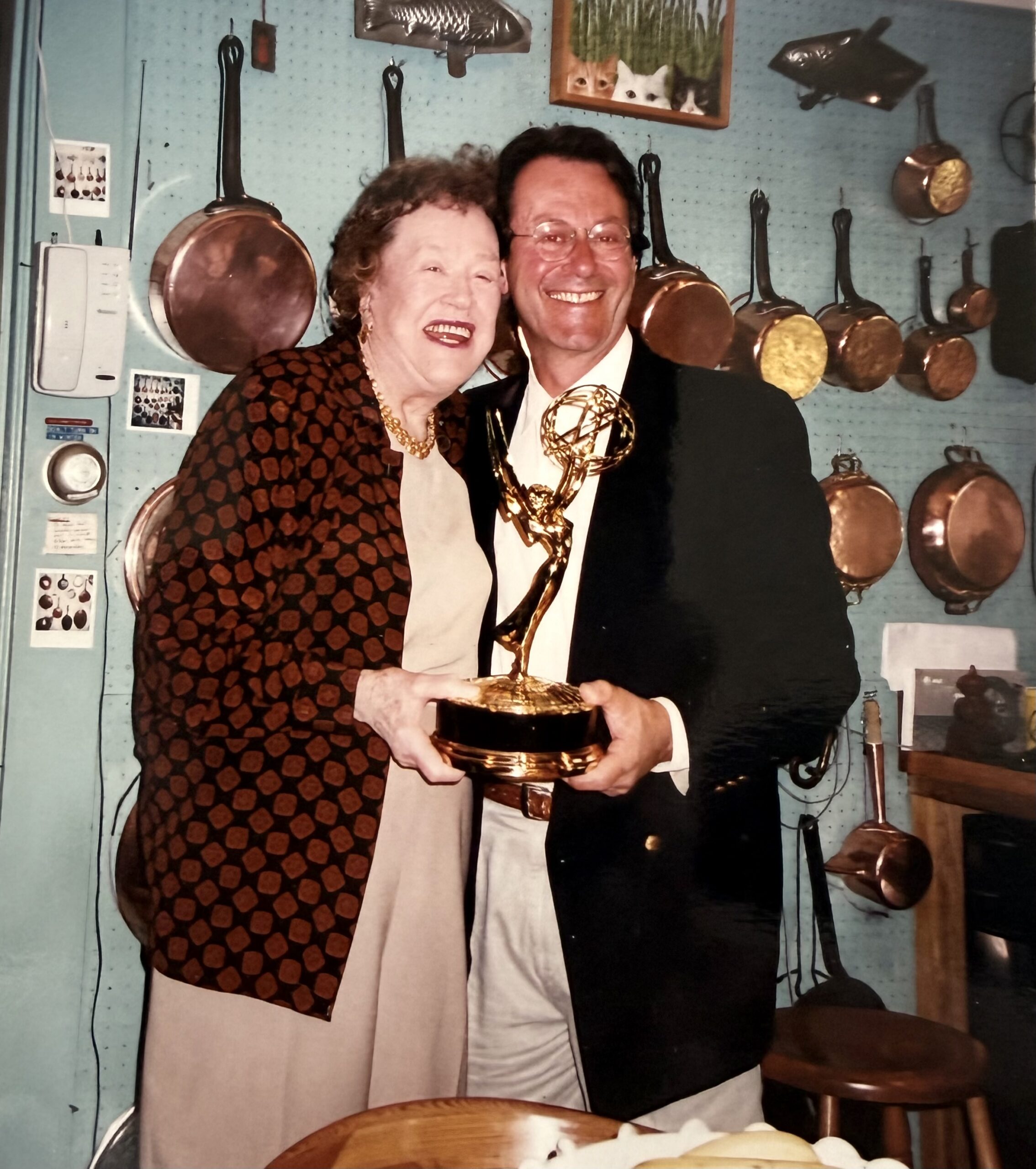
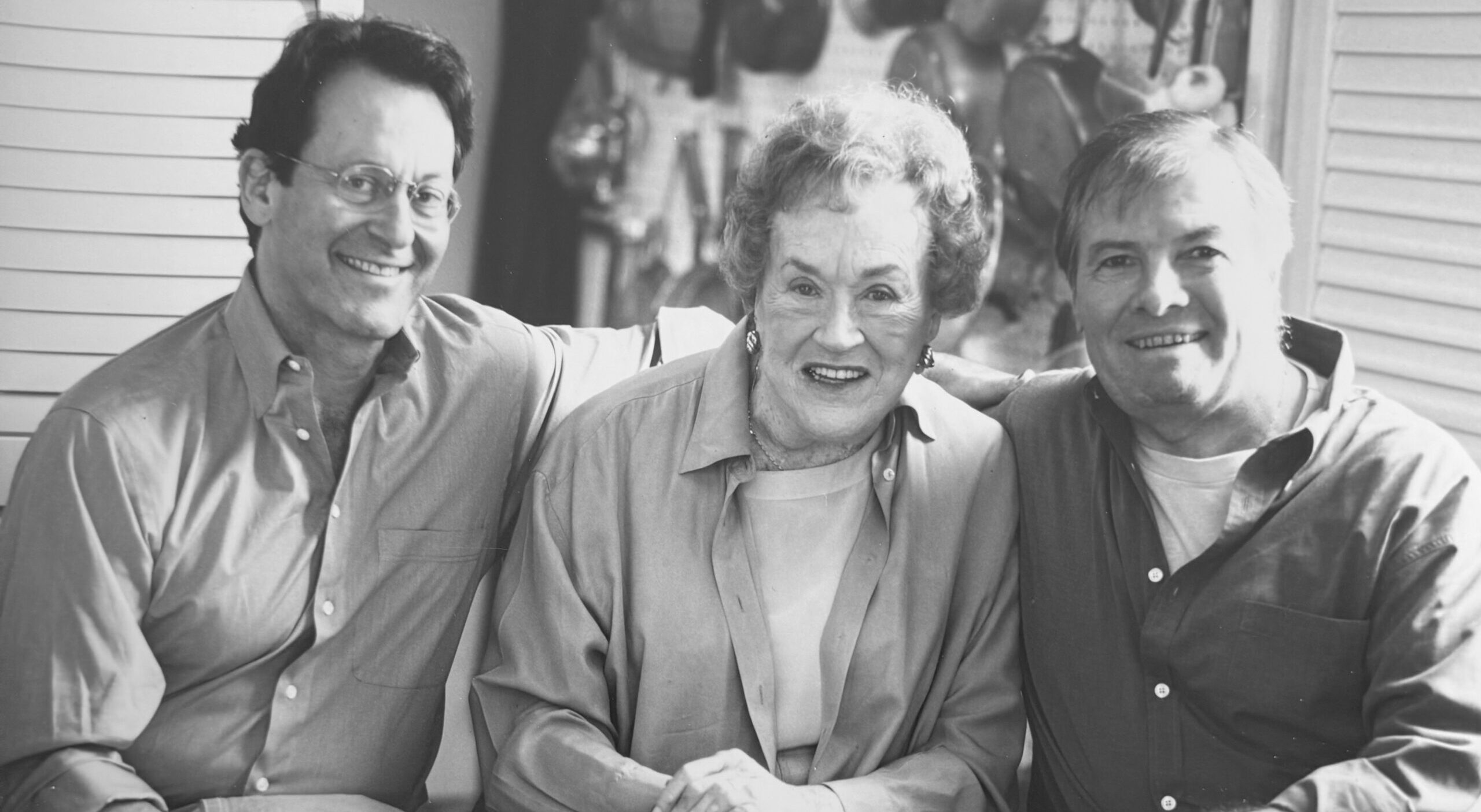
I think that the one we did with Julia and Jacques in her kitchen Cooking at Home – aside from wining tons of Beard and Emmys, all of those kinds of things audience-wise, that’s the show that has endured more than any of our other shows. He might not agree with me, but I think every time I read something about Jacques, he always talks about that series, because I think that’s the series that put him at the same level as Julia, and he was brilliant with her. Absolutely brilliant, the combination of generosity and his skill level; it was a combination of almost-like being her son and her mate. There was a really genuine affection, and yet a kind of mischievousness that you have between son and mother. And the food they did was amazing. And it was funny.
What’s your average day like now? Are you retired from food?
GD: We ended A La Carte which was our company around 2010, 2009. Nat continued to do stuff in the Bay Area, less media, although I know he produced a film. It wasn’t in the food world, and I continued working independently with Eric Ripert, 3-star Michelin restaurant Le Bernardin in New York; we did three different TV series.
I remember that.
GD: Eating all over the world, Avec Eric. We had a great time.
Why didn’t that continue?
GD: We just stopped. The combination of the last one we did, we didn’t do it with PBS, we did it with Food Network, but I was really directing and producing it. The people who packaged it were an agency called Anomaly in New York, like a big advertising agency and they put this stuff together. Eric started doing more stuff with Bourdain until Bourdain died. But we had a great time, they were terrific shows, and they were acknowledged. We won a Beard for Best Location TV series and we won two Emmys. And I started working as a visiting professor at Stonybrook University and running a thing called “Food Lab” and did that while continuing to do TV production and consulting. Helping people package stuff. And that’s what I do now. I’ve been involved in a couple projects; do you know who Ruth Reichl is?
Yes, she also had a PBS show; I miss seeing her!
GD: Gourmet. And before that was the restaurant critic for the L.A. Times and before that, the New York Times.
Are you talking about doing another show with her?
GD: We continue to talk about it. Part of it is we’re all old, it’s true, and the mass audience, less-so public television, but public television has such a tiny audience now, when we were doing Julia in the beginning, public television stations had like 20 percent of their market share, now they’re probably one percent and all of broadcast television isn’t even 20 percent anymore.
I interviewed Scott Yoo, who hosts Now Hear This, and he told me that the reach is still really general and broad, that people recognize him.
GD: The reach is great, but that’s the way you sell sponsorships by talking about the reach. But when you start getting into the specific numbers, it falls down. The reach is pretty universal, and especially now with streaming and Create, and maybe PBS-Digital, and so on, the shows are out there, the question is getting people to watch it. I started doing this TV series with Chris Kimball called America’s Test Kitchen in Boston. It was eight years after Food Network was going, it was the perfect public television cooking show. It was filled with serious research, it was a little nerdy, and there was Chris and his bowtie and suit, but we had a great ensemble, we had a great group of people. And it worked really well. And it’s still on, Chris went to do another show.
You’ve really had your hands in every PBS show, except for the original.
GD: I did. We did Martin Yan’s show by the way.
Wow!
GD: It was fun. And we were the game. That was the amazing thing, PBS was the game. We introduced Emeril, but Emeril, when he first went on Food Network, there wasn’t much there and then once they realized his talent, and gave him a platform where he could really be Emeril, he built the Food Network. Remember when he was on 8 hours a day, or more? What Emeril did – Julia was all about teaching people to cook, and how much fun it was to learn how to cook and making it entertainment. Emeril was about food as entertainment, and he brought entertainment and fun.
What is your favorite Julia Child memory? You must have so many.
GD: I do, I have many. And I don’t want to say it’s one specific thing – but Julia Child talking about being a kid and growing up in Pasadena and going out with her dad for an ice cream sandwich; and how much she loved the ice cream sandwich. But the main thing that she did when she talked about that ice cream sandwich, and this was when she was 80-somethibg years old, she had a smile on her face which I took like the exact same smile she had when she was 7 years old in that ice cream parlor, getting handed the ice cream sandwich. And I’ve seen that smile on her face several times. The other time was when she and Jacques Pepin made these enormous cheeseburgers together. And Jacques said, “This cheese burger is almost so big, I cant fit in my mouth.” And Julia just looked at him and again, gave that same smile of Julia as a little girl and some real American food.
You had to travel with her to some shoots for Cooking with Master Chefs. Travelling can be difficult. How were those trips, any memories that stand out?
GD: We had incredible trips and Julia was an amazing traveller, always insistent on puling her own bag, which Paul her husband had monogrammed with foot high letters “JC” in script on the side of her bags, so they could always be found. She was always there, always present. I would say the only time in airports that she would disappear is when she wanted to go off and sample the fast-food places in different airports, whether it was Pizza Hut, this was before Shake Shack, but she’d sometimes come back to the plane bringing food and she’d say “Hot dogs!” with an emphasis on “dog” rather than “hot,” just so pleased. And she always tasted everything. Didn’t always love it, but always tasted everything that was served to her.
What was one big takeaway you learned from knowing her in food and in life?
GD: Her by-word, which has been adopted by so many people, which is “Taste, taste, taste,” her go-to expression. And I always took that to mean – not just taste your food, but taste life.
Did you ever watch the Julia movie that Nora Ephron did, or the Julia HBO show, because I wish that someone would do a proper movie; with Julie & Julia I would always fast forward to the Meryl Streep parts.
GD: Yeah.
Did you have any feeling about it? You were there and knew her.
GD: I loved the Julie & Julia film that Nora did. I thought it was brilliant the way that she set up the two characters. I thought that Amy Adams played the role terrifically. She played the role of a person really well, she captured Julie Powell, but here she is stuck in this little apartment in Long Island City across from the elevated train going-by, cooking out recipes in a small kitchen and here’s Meryl, one of the greatest, if not the greatest actors of our time, in post-war Paris (laughs). The premise, the way it was done was great. The backstory on that was that Meryl, according to Nora when I spoke to her, did not really want to portray people who were involved in TV, because this was really all about Julia before TV.
Did Nora consult with you?
GD: No, I knew her socially. There was no consulting because I was not there. That movie was really before there were even any ideas about TV.
How did you feel about the HBO show?
GD: I thought that Season One was really good, I really enjoyed it. I thought David Hyde Pierce was great as Paul. I thought he was really, really good as Paul, and captured Paul in a way that he was not presented in Julie & Julia, so I thought he did a brilliant job with it. Sarah Lancashire, who was not cast to-type necessarily, really captured Julia as well. For whatever reason, Season Two – they went off story, it started being less about Julia and more about all these characters. And what we really wanted to see was the Julia story. That was why Julie Julia worked. And that’s why Season One worked; I thought Season One was really good.
I loved Season One too, and I do wish someone would do a proper movie, like elongate the Julia part.
GD: Yeah. And nobody’s ever really done a great Julia doc.
Or movie! I wish there was more.
GD: Yeah, a second movie.
Sarah Moulton was on record, she hated the HBO show, because she knew Russ.
GD: I thought as a character he was fine in that, that wasn’t a documentary. There was a documentary that didn’t work, it was American Masters and there was a CNN one.
Was it awful because they didn’t use primary sources.
GD: They didn’t capture Julia, they didn’t capture the spirit, the direction. If someone was going to do a documentary on Julia, I would say, “Look at Julia’s social activism and political activism and engagement with the world around her.” She was an amazing person that went way beyond the kitchen, and way beyond – everyone likes to talk about how she came from wealthy family in Pasadena. But the interesting story is she came from a wealthy family in Pasadena and basically turned her back on a lot of the ultra-right wing Republicans. She was very engaged with Margaret Sanger and Planned Parenthood. She was an amazing person and used her clout, with her energy, to really help good things happen. And she felt very strongly about food, when she was doing it – food and cooking were for homemakers, for pretty much white middle class women who weren’t working. And look at how the world has changed. And she talked about food and community, she brought people together around food. She talked about the joy of the table, not just the joy of cooking, but the joy of the table. That’s so important.
KLCS Public Media members can stream hundreds of classic Julia Child shows, anytime, on KLCS|Passport.
You can follow Geoffrey’s LinkedIn profile to learn more about his current work.