
[This interview has been edited for length and clarity, you can read the full version of this interview on our website: www.KLCS.org]
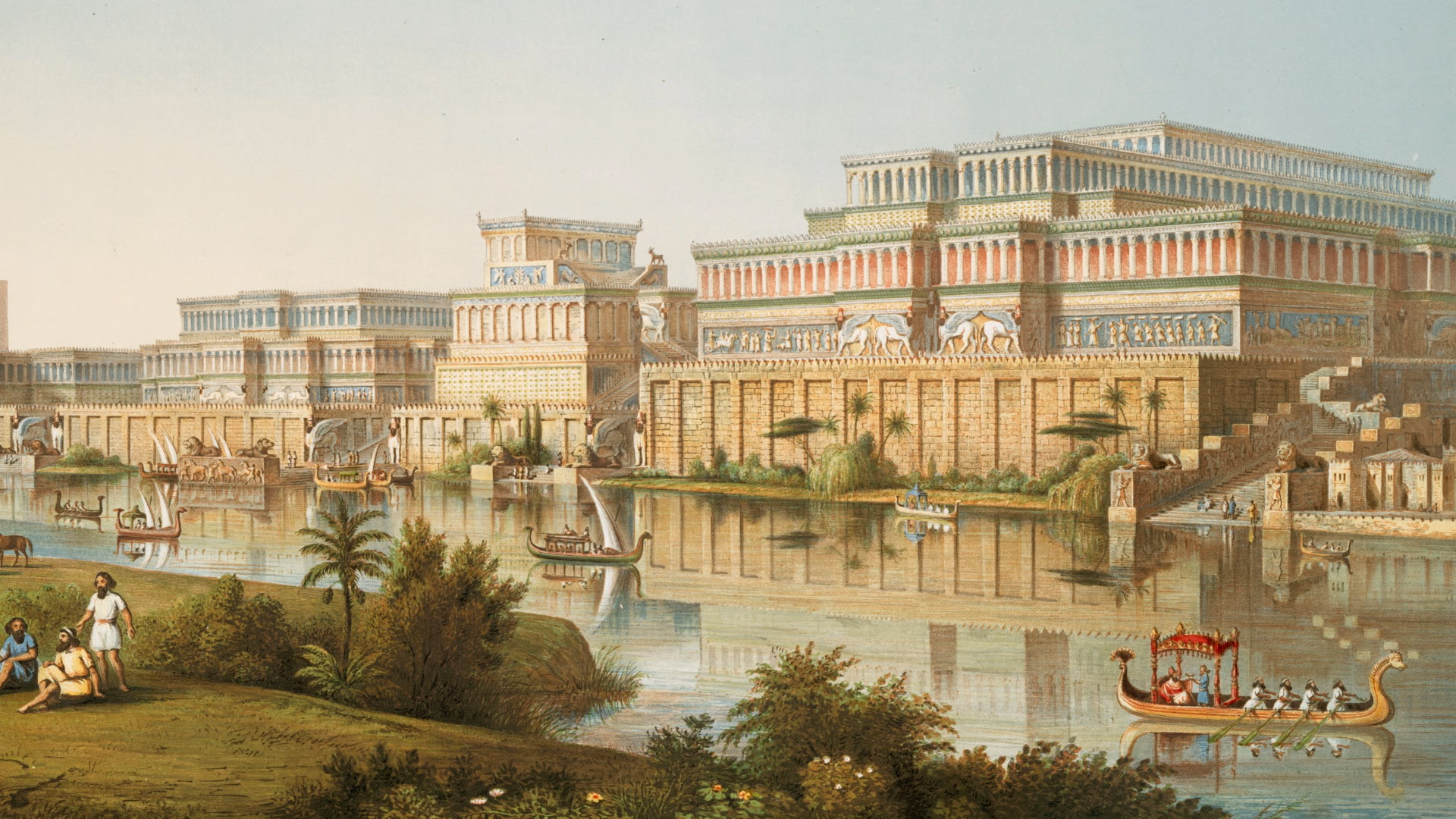
It’s history’s greatest cold case: the legendary Hanging Gardens of Babylon, a paradise of lush, terraced greenery said to have been built for a homesick queen. It’s the only one of the Seven Wonders of the Ancient World that has never been found… and some experts even wonder if it was just a myth. But what if everyone has been looking in the wrong place?
In a real-life Indiana Jones adventure, the new Secrets of the Dead episode, “Returning to Babylon,” follows a team of brilliant, passionate experts on a quest to uncover the truth. We talk with the man who was in the trenches, London-based producer Marc Tiley, who went boots-on-the-ground on this emotional and potentially game-changing dig.
Marc, many of us have heard of the Hanging Gardens of Babylon but that was so long ago, it seems it’s disappeared into history. What was the impetus for this episode?
MT: The Hanging Gardens is one of the ancient Seven Wonders of the world and it’s the only one that’s never been located. So its always been a mystery and what’s interesting is that Babylon – the city is in Iraq, is in the south, and people have looked there for decades and never found the gardens. But Babylonia stretched right across Iraq, and its other main capital was Nineveh, which is now Mosul. So some people have been looking there. And it makes perfect sense, because the people who wrote about these Seven Wonders of the Ancient World were Greek writers. They never actually got as far as Babylon, so they were writing about it without ever having been there. So, all the other places they’ve been to – the pyramids, the Colossus of Rhodes; they were writing about it having heard about this great wonder. At the time Babylonia was Iraq, so that mystery has always endured because it’s never been located. Some people we’ve met, have found evidence that it’s in Mosul. So, that, coupled with the fact that in recent years archaeologists have been allowed back in there, and they’re finding lots of new things just seemed like an opportunity not to be missed: that they were finding new clues about all kinds of parts of this history.
Was there full cooperation with the Iraqi government? Were you on-site and if so, was there any fear for you to be on-site?
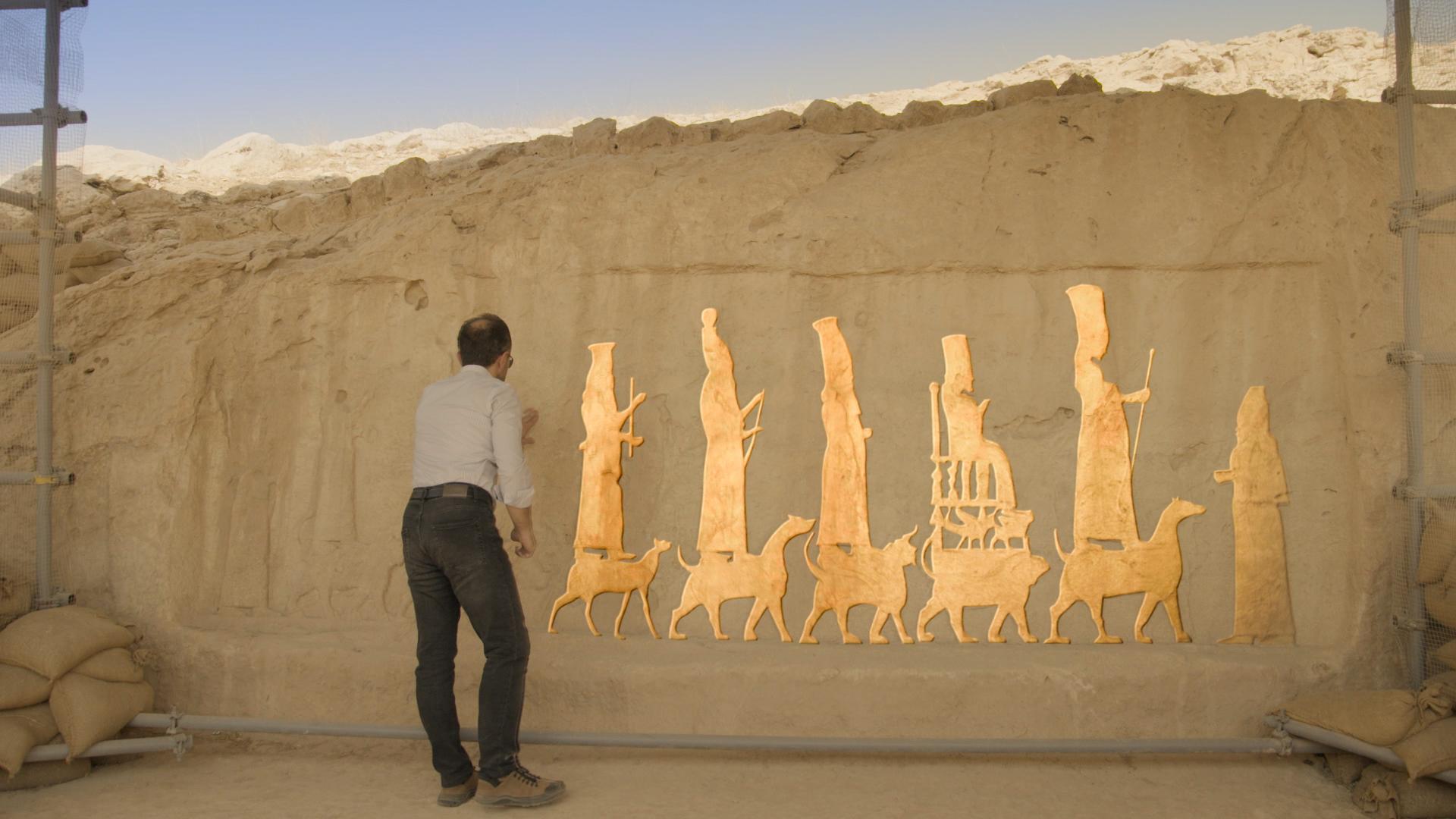
MT: Yeah, there was full cooperation. It took a lot of setup. I went there in May [2023] to actually meet the authorities, because doing it remotely doesn’t really cut it over there; you have to go over there. I met lots of authorities, lots of people, and then I had five minutes with the boss. I had my shot to tell him about the project and he looked at my fixer, and they had a little chat and he came back and he just nodded and that was the nod. We had lots of the archaeologists on board, but we needed the Iraqi government’s rubber stamp. And that we got. So, once we got that, we knew we could go back for filming, which was September [2023]; we had their full support, absolutely. When I went there, we had armed guards. The city itself is quite heavily guarded, still, even though it’s safe, up to a point. Tourism is coming back to Iraq, but only certain parts of the country. But importantly, the archaeologists live in a secure compound which is guarded. When they got to work, they go in a convoy to the site, they don’t go into the city. They work for a few hours and then go back to the compound, so, although the city has been free from conflict for a few years, there’s still tension.
What was your journey to making this type of important television, chronicling history being uncovered?
MT: I think Iraq opening up – this is an Iraq that you don’t see in the news, really. And all that time during the years of conflict, I think everyone seeing those videos of Isis smashing up museums and stuff was just horrifying. Hearing about that rebuilding felt like an important story – it’s not just about destruction here. This is actually a rich civilization that they’re very proud of. That really became the motivation and Iraqi has been at the center of human civilization for thousands of years, so a chance to show another side of it was the main journey I think for everyone involved. It’s really inspiring. After speaking to a few people you begin to get the sense that, “Oh, yeah, everyone’s pushing in the same direction here.” It’s really quite an inspiring story.
This seems like such an important mission – since this is the cradle of civilization. It’s hard to fathom how anyone would have such a low regard for their own heritage to destroy priceless, irreplaceable artifacts; regardless of whatever religion they are.
MT: Very much so. Unfortunately, it’s been part of conflict for millennia. The invading force tried to destroy the history of the people that are there. But I think to the extremists in that situation – any other idol is a false idol, and I think the extremists also would say to worship any idol is also blasphemy, so any imagery: they’re iconoclasts in that regard. That’s obviously terrible, but in this case obviously the destruction of the [artifacts] smashed into a million pieces are really hard to rebuild. But their destruction does have a silver lining, slightly, in that it has allowed archaeologists to find things they never have. In the tunnels, they found a new palace. Even though they’re rebuilding, there’s small window of opportunity while the city is rebuilding to actually find new things. So, though it’s terrible, and no one would want it to happen, there was a small silver lining in that it has forced some new discoveries. There’s also looting as well, it’s a really complex city with a lot going on.
I loved learning there are Assyriologists like the German professor and the retired professor in England, Stephanie Dalley, who decoded what the tablet describing the garden of the king and how, maybe, that was the Hanging. Did this project leave you with a feeling that a second show is needed, to continue the journey? I think there could be an unscripted show following this story and the two on-the ground Iraqi experts – including the museum director.
MT: We’re still in touch with them. The work will be ongoing, with the tunnels and the palace; with the German professor, his work won’t be able to continue because they’re building a new huge mosque on top. So that particular discovery is a once-in-a-lifetime chance, it’s like before they build it, you can explore. Stephanie’s work, yeah she’s done incredible work.
Working in the history space, are you surprised that we are still able to uncover things that are thousands of years old?
MT: Yeah, constantly. It’s very exciting, I’ve been making history programs forever, it’s just endlessly fascinating. There’s always something new found, or a new interpretation of something old. I think the general public are interested because there’s always some connection they can find. In some ways history teaches us everything, and also nothing at the same time. And I think you feel the humanity across the ages sometimes, and when you get that moment, history feels important. In Iraq you can imagine it’s so important – what the narrative is; it is absolutely central to their lives.
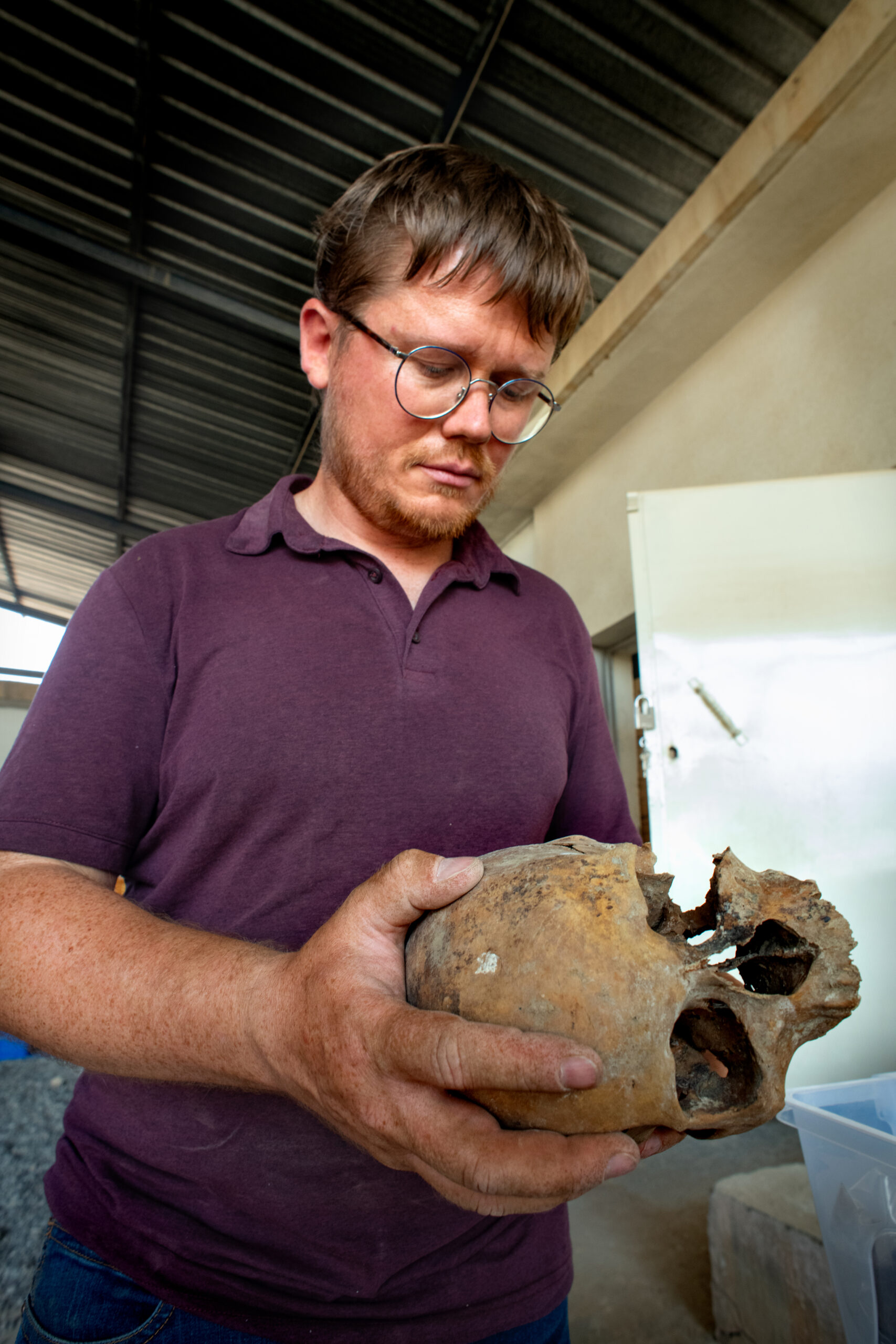
It must be a fulfilling experience to chronicle history and help uncover history. Does the scope of the work ever hit you, in general, or in this project?
MT: Yeah, and particularly with this one, it felt like it’s history, but it’s kind of being preserved for future generations. There was this sense of “We can’t let this kind of destruction happen again.” So it felt like a project about the past, but for the future. And I’ve never really articulated it like that, so I haven’t thought about it, so thanks for the question. But that’s what it felt like.
[This interview has been edited for length and clarity, you can read the full version of this interview on our website: www.KLCS.org]
Watch Secrets of the Dead “Returning to Babylon”, as well as other episodes and seasons, on-demand via KLCS|Passport: watch.klcs.org.
Visit the show’s official website to learn more: www.pbs.org/wnet/secrets/